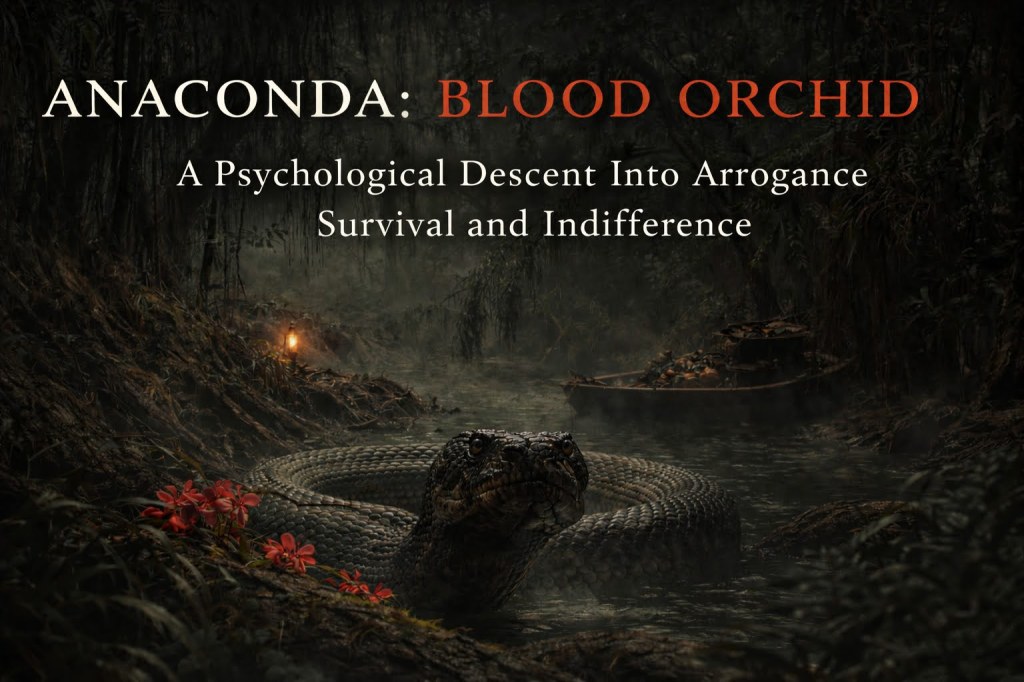
The Film Is Not About Snakes
Despite its title Anaconda Blood Orchid is not fundamentally about giant serpents. The snakes are symptoms not causes. The real subject of the film is human intrusion the belief that intelligence planning and ambition can tame environments that predate us and will outlast us.
The jungle does not behave like an antagonist because it does not need to. It does not react. It does not negotiate. It simply exists. The terror of the film comes from the realization that the environment has no interest in human survival and worse no awareness of human intention.
This indifference is what breaks the characters.
Arrogance as the Original Sin
Every decision that leads the characters deeper into danger is rooted in a familiar psychological error the assumption that knowledge equals control. The expedition is driven by expertise logistics and technology yet none of these tools matter once the environment reasserts its dominance.
This mirrors a broader human tendency especially modern humanity to confuse information with mastery. The characters do not enter the jungle as explorers they enter as extractors. The rare orchid is not beauty not mystery but resource. Something to be taken monetized justified.
The film quietly suggests that this mindset is incompatible with survival.
Fear Collapses Identity
One of the film’s most unsettling undercurrents is how quickly social roles dissolve. Leadership professionalism and moral posturing disappear under pressure. When the threat becomes immediate and physical the human psyche reverts to instinct.
This is not portrayed as villainy. It is portrayed as inevitability.
People lie. They abandon. They rationalize betrayal as necessity. The film does not condemn these choices it observes them. In this way Blood Orchid is less interested in heroism and more interested in psychological stripping what remains when identity is no longer socially reinforced.
The Snake as an Archetype
The anaconda itself functions less as a creature and more as an archetypal presence. It is silent ancient and unstoppable. It does not stalk out of malice. It consumes because that is its nature.
This places the human characters in an uncomfortable position they are not victims of evil only participants in a natural order they do not belong to. The horror comes from recognizing that the snake is morally neutral while the humans are burdened with intention desire and fear.
The imbalance is existential.
Inevitability Over Spectacle
What separates Anaconda Blood Orchid from louder genre films is its commitment to inevitability. The film does not suggest escape is earned through virtue or cleverness. Survival feels accidental not deserved.
This is philosophically important. The movie rejects the comforting lie that intelligence guarantees safety. Instead it presents survival as conditional temporary and often arbitrary. The jungle allows some to leave not because they are worthy but because it has no reason to stop them.
That lack of meaning is the meaning.
Why This Film Lingers
Most creature features fade because they rely on shock. Blood Orchid lingers because it unsettles something deeper the idea that humanity is fragile intrusive and fundamentally out of place in certain corners of the world.
It is a reminder that nature does not punish arrogance out of justice it simply removes those who fail to respect its scale.
Final Reflection
Anaconda Blood Orchid succeeds not despite its simplicity but because of it. By refusing emotional manipulation or moral reassurance the film exposes a raw psychological truth when stripped of comfort and control humans are not exceptional they are temporary.
That recognition is what makes the film quietly disturbing long after the credits roll.

 Shayan Afzal
Leave a comment